Welcome
The Budapest–Marseille–Wuppertal (BMW) collaboration studies quantum chromodynamics (QCD), the theory of the strong interaction, with large-scale numerical simulations on a space-time lattice. See the list of members and the publications of the collaboration.
Selected results
Muon g−2: theory and experiment agree
The magnetic moment of the muon, a heavier, short-lived cousin of the electron, can be both measured and computed with extraordinary precision, which makes it one of the most stringent tests of the Standard Model. The experiments at Brookhaven and Fermilab have measured its anomalous part, , to 127 parts per billion. On the theory side, the largest uncertainty comes from the leading-order hadronic vacuum polarization (LO-HVP), the effect of quarks and gluons that the muon briefly interacts with. Together with the DMZ group (M. Davier, B. Malaescu, Z. Zhang), we computed the LO-HVP with a hybrid method: lattice QCD+QED for Euclidean times up to 2.8 fm, which give more than 95% of the result, and and -decay data only for the small long-distance tail. Simulations on finer lattices, down to 0.048 fm, reduced the uncertainty of our 2020 result by a factor of 1.6, to , a precision of 0.48%. Combined with the other contributions, the Standard Model prediction agrees with the measured value to within 0.5 standard deviations (A. Boccaletti et al., 2026).

Muon g−2 from lattice QCD at 0.8% precision
Until 2020, the Standard Model prediction for the magnetic moment of the muon relied on a dispersive (R-ratio) evaluation of the LO-HVP, based on measured cross sections of electron–positron annihilation into hadrons, and it disagreed with the measurement by about 3.7 standard deviations. We computed this contribution from first principles, with lattice QCD and QED: four flavours of staggered quarks at their physical masses, six lattice spacings down to 0.064 fm, volumes up to 11 fm, and all strong isospin-breaking and electromagnetic effects included to leading order. The result, , has a total uncertainty of 0.8%, precise enough to discriminate between the measurement and the dispersive predictions. It favours the measured value of over the dispersive ones (Sz. Borsanyi et al., 2021).

The neutron–proton mass difference
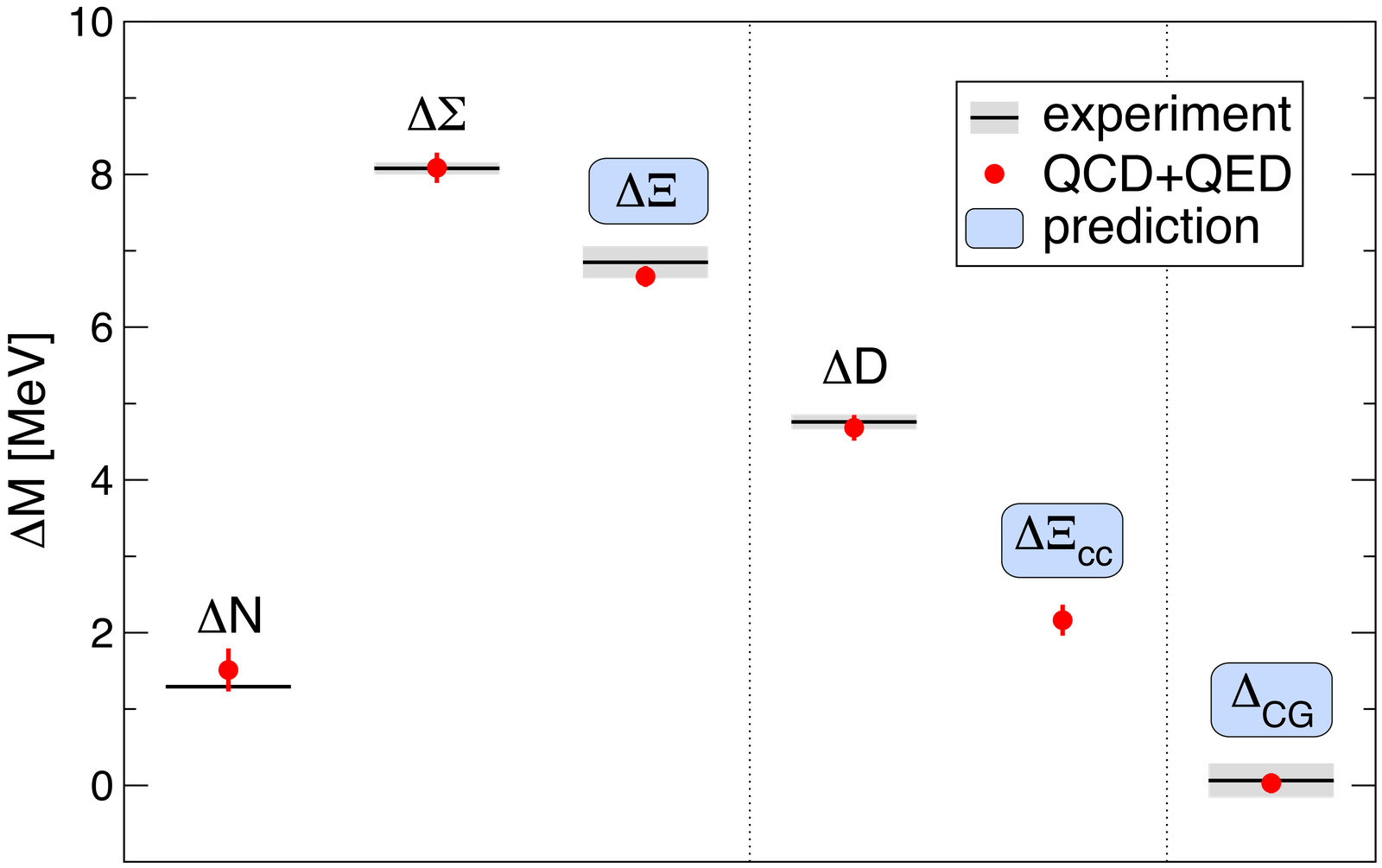
The neutron is heavier than the proton by only 0.14% of their average mass, yet this tiny difference shapes the universe: if it were smaller than about a third of its value, hydrogen atoms would undergo inverse beta decay, leaving mostly neutrons. The difference results from a subtle cancellation between two effects: the down quark is heavier than the up quark, which makes the neutron heavier, while electromagnetism makes the proton heavier. We computed both, in simulations of QCD and QED with four non-degenerate flavours of Wilson quarks (up, down, strange, charm). We obtained MeV, compared with the measured 1.29 MeV and greater than zero by five standard deviations: 2.52(17)(24) MeV come from the quark mass difference and −1.00(07)(14) MeV from electromagnetism. We also determined the splittings in the , , and isospin multiplets, in some cases more precisely than experiment (Sz. Borsanyi et al., 2015).
The light hadron spectrum
More than 99% of the mass of the visible universe is in protons and neutrons, but only a small part of their mass comes from the quarks they are made of: about 95% is the energy of the strong interaction between quarks and gluons. We computed the masses of the proton, the neutron and other light hadrons from first principles, in lattice QCD with 2+1 flavours of dynamical Wilson quarks. Simulations with pion masses down to 190 MeV, three lattice spacings and large volumes allowed us to extrapolate to the physical quark masses, to the continuum and to infinite volume, with all uncertainties under control. Only three inputs are needed: the , and masses fix the light and strange quark masses and the overall scale. All other masses agree with experiment; for example, the nucleon mass comes out as 936(25)(22) MeV, compared with the measured 939 MeV (S. Dürr et al., 2008).
